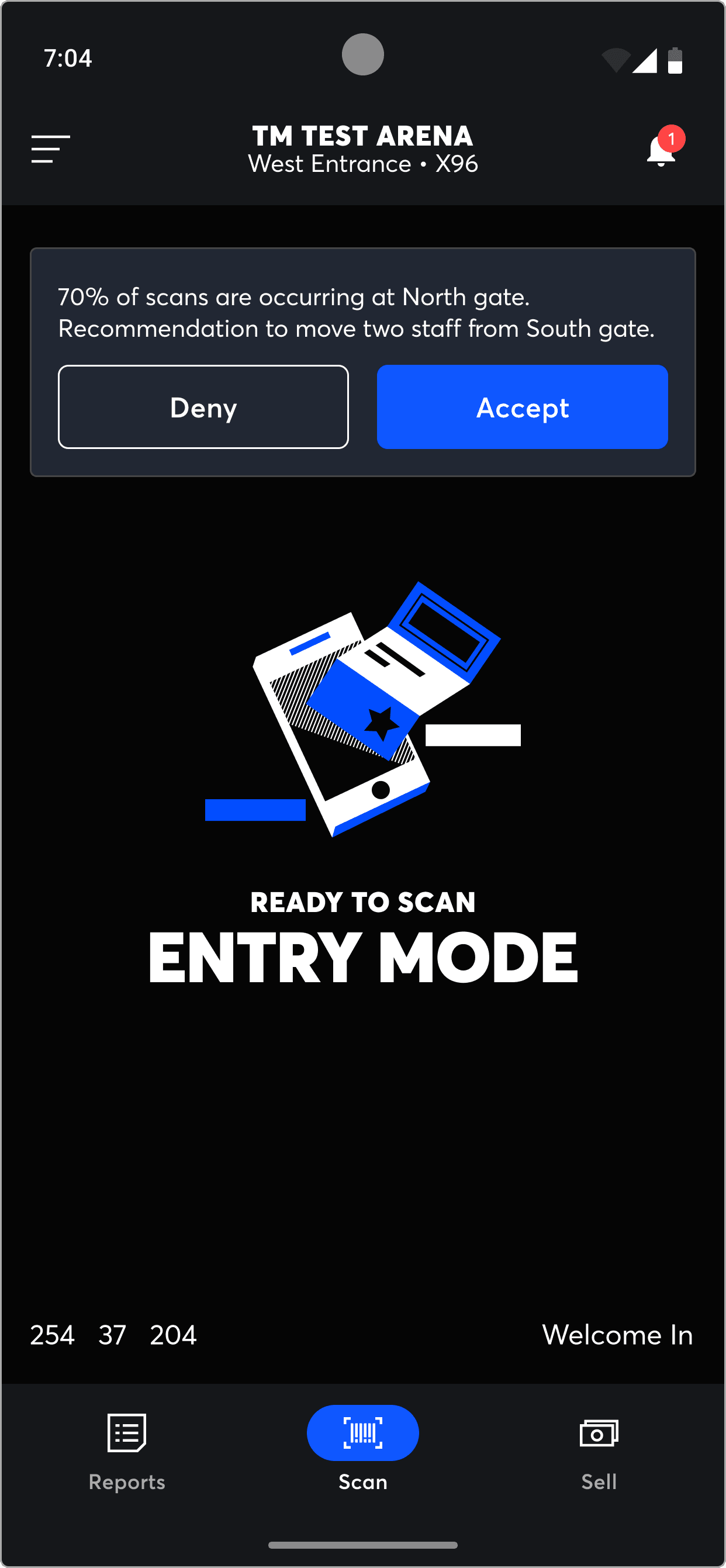
Event Day Mobile App
Company:
Ticketmaster
Release
Q4 2025 - Ongoing
Team:
15 people
Ticketmaster supports two separate scanning apps. The TM1 Entry Scanning App (Horizon), used primarily in North America, relies on an outdated codebase and specialized hardware. TM1 Access, used internationally, supports a wider range of devices but has fewer features and capabilities to handle large events and does not meet modern security standards.
This project is part of a broader effort to consolidate scanning into a single platform and lay the foundation for a unified venue event day app.
Ticketmaster supports two separate scanning apps. The TM1 Entry Scanning App (Horizon), used primarily in North America, relies on an outdated codebase and specialized hardware. TM1 Access, used internationally, supports a wider range of devices but has fewer features and capabilities to handle large events and does not meet modern security standards.
This project is part of a broader effort to consolidate scanning into a single platform and lay the foundation for a unified venue event day app.
THE RESEARCH -
This project was grounded in real-world observation across 4 continents and 13+ markets. We conducted on-site venue visits during live events, interviewed field operations staff, tested prototypes with scanning staff and ran design workshops with engineering and stakeholders. This ensured we understood what users actually experienced during high-pressure ingress scenarios.
This project was grounded in real-world observation across 4 continents and 13+ markets. We conducted on-site venue visits during live events, interviewed field operations staff, tested prototypes with scanning staff and ran design workshops with engineering and stakeholders. This ensured we understood what users actually experienced during high-pressure ingress scenarios.


RESEARCH THEMES -
Real-Time Analytics
Real-Time Analytics
staff rely on live data to make staffing decisions, alert supervisors to issues, and identify bottlenecks before they impact fan flow
staff rely on live data to make staffing decisions, alert supervisors to issues, and identify bottlenecks before they impact fan flow
Mobile First Design
Mobile First Design
Desktop dependence creates operational friction, forcing staff to leave their area for minor tasks like reassigning a device to a different entrance
Role-based permissions
Role-based permissions
Scan-only ushers need restricted access to prevent accidental mode switching, while supervisors require elevated capabilities for troubleshooting and monitoring
Scan-only ushers need restricted access to prevent accidental mode switching, while supervisors require elevated capabilities for troubleshooting and monitoring
Improved scan feedback
Improved scan feedback
audio and visual cues need substantial improvement to clearly communicate rejected tickets and offline status in chaotic venue environments
PHASE 1 MVP -
The MVP validates core scanning functionality and establishes the mobile UI design foundation. Success was measured by adoption rates (% of tickets scanned with new app vs. old per event) and user satisfaction via post-event surveys.
The MVP validates core scanning functionality and establishes the mobile UI design foundation. Success was measured by adoption rates (% of tickets scanned with new app vs. old per event) and user satisfaction via post-event surveys.
MVP IDEATION -
I produced extensive design explorations with multiple concepts for phase 1. During design reviews with leadership and product operations teams, I validated detailed IA diagrams that mapped the app and presented options for feedback on key screens. A major challenge was the TM1 enterprise design system is desktop-focused and didn't translate to mobile. I led the effort to create a mobile-friendly UI version, working cross-functionally with marketplace designers, engineering and the design system team to align on visual style, create components and establish mobile-specific interaction patterns. This work ensures patterns can scale to the full venue staff app vision.
I produced extensive design explorations with multiple concepts for phase 1. During design reviews with leadership and product operations teams, I validated detailed IA diagrams that mapped the app and presented options for feedback on key screens. A major challenge was the TM1 enterprise design system is desktop-focused and didn’t translate to mobile. I led the effort to create a mobile-friendly UI version, working cross-functionally with marketplace designers, engineering and the design system team to align on visual style, create components and establish mobile-specific interaction patterns. This work ensures patterns can scale to the full venue staff app vision.


FINAL DESIGNS -
The app launch took place at Big Night Live in Boston where we observed the app during a live event. During the event we wanted to validate the basic scanning functionality and gather feedback. Staff adapted quickly to the new app, liked the appearance and new experience for rejected tickets (requires a user confirmation in the new app). We received feedback that time between scans was too slow and were able to get that directly incorporated for the new release.
The app launch took place at Big Night Live in Boston where we observed the app during a live event. During the event we wanted to validate the basic scanning functionality and gather feedback. Staff adapted quickly to the new app, liked the appearance and new experience for rejected tickets (requires a user confirmation in the new app). We received feedback that time between scans was too slow and were able to get that directly incorporated for the new release.


PHASE 2 -
Phase 2 launches the app on Google Play and App Store, enabling BYOD capabilities for venues globally. This requires implementing user authentication and device authorization to meet security standards. Success will be measured by international venue adoption rates,particularly the 37% of TM1 Access clients who depend on BYOD, and the retirement of the TM1Access app.
Phase 2 launches the app on Google Play and App Store, enabling BYOD capabilities for venues globally. This requires implementing user authentication and device authorization to meet security standards. Success will be measured by international venue adoption rates,particularly the 37% of TM1 Access clients who depend on BYOD, and the retirement of the TM1Access app.
SECURITY CHALLENGE DISCOVERY -
Moving to this new app with bring your own device capability introduced a critical security requirement of user authentication and device authorization to protect sensitive data. We knew this security measure would add friction to venue operations where ushers arrive minutes before doors, share devices mid-shift, and work across multiple venues. We conducted extensive research on authentication patterns, studying how other venue staff apps (Moshtix, Posh, Universe) handled security while maintaining operational speed.
Moving to this new app with bring your own device capability introduced a critical security requirement of user authentication and device authorization to protect sensitive data. We knew this security measure would add friction to venue operations where ushers arrive minutes before doors, share devices mid-shift, and work across multiple venues. We conducted extensive research on authentication patterns, studying how other venue staff apps (Moshtix, Posh, Universe) handled security while maintaining operational speed.


Then, I ran a workshop with engineering to brainstorm all potential angles we could take that balance user needs and security.
Then, I ran a workshop with engineering to brainstorm all potential angles we could take that balance user needs and security.
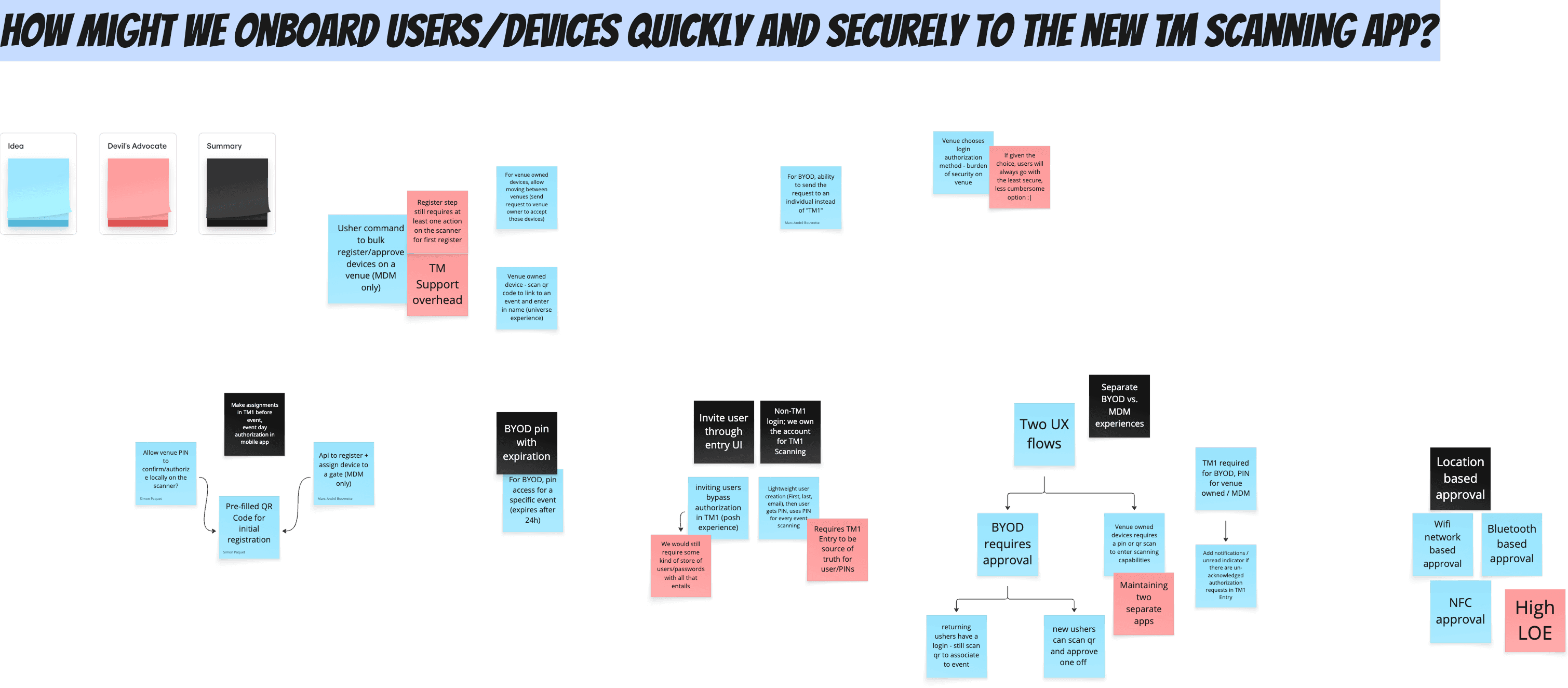
Next, I mapped each persona to understand how authentication would impact their on-site workflows which revealed critical edge cases and helped us prioritize.
Next, I mapped each persona to understand how authentication would impact their on-site workflows which revealed critical edge cases and helped us prioritize.


PHASE 2 DESIGNS -
I tested the designs with internal and external users to validate the flow was intuitive. While users were apprehensive about the friction this would cause on event day, they were able to navigate the UI with ease which gave us confidence in releasing phase 2.
I tested the designs with internal and external users to validate the flow was intuitive. While users were apprehensive about the friction this would cause on event day, they were able to navigate the UI with ease which gave us confidence in releasing phase 2.
THE VISION & VALUE -
To get buy in for the app, I created a vision for the TM1 Scanning App that consolidates box office, guest services, and scanning in one mobile experience. The value:
For Venues: iOS + Android flexibility, enhanced security and less context switching between applications and devices on event day.
For Ticketmaster: Move out of hardware management, one application to maintain, enable global standardization of access control and create new revenue streams through mobile selling.
For Fans: Faster entry, better real-time support and seamless in-venue upgrades and purchases.
More to come!
To get buy in for the app, I created a vision for the TM1 Scanning App that consolidates box office, guest services, and scanning in one mobile experience. The value:
For Venues: iOS + Android flexibility, enhanced security and less context switching between applications and devices on event day.
For Ticketmaster: Move out of hardware management, one application to maintain, enable global standardization of access control and create new revenue streams through mobile selling.
For Fans: Faster entry, better real-time support and seamless in-venue upgrades and purchases.
More to come!